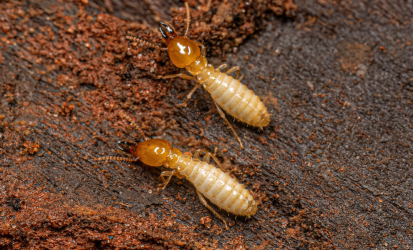
If you own a landed property in Singapore, there is one silent threat moving beneath your feet right now: subterranean termites.
Unlike other pests you might spot scurrying across the floor, these destroyers operate in secret. They live in the soil, building massive underground colonies, and enter your home without a single warning. By the time you see the damage, they may have already compromised your property’s structural integrity.
For homeowners searching for termite treatment Singapore, understanding subterranean termite Singapore behaviour is not just academic—it is financial protection.
At Pestopia, we specialise in identifying, eliminating, and preventing these hidden enemies using advanced science and NEA approved pest control methods. This guide explains everything you need to know about subterranean termite control Singapore, why termite soil treatment is essential, and when to call a subterranean termite exterminator Singapore.
Why Subterranean Termites Are Singapore’s Most Destructive Pest
Singapore’s warm, humid climate creates a paradise for termites. Among the local species, the Asian subterranean termite (Coptotermes gestroi) is the most aggressive .
Here is what makes them so dangerous:
They live in the soil. Unlike drywood termites that live inside the wood they eat, subterranean termites build their colonies underground. They travel up through cracks in your foundation, expansion joints, and plumbing penetrations to reach the timber in your home .
They operate in huge numbers. A single colony can contain hundreds of thousands—sometimes millions—of workers. These workers never sleep. They eat cellulose 24 hours a day, silently hollowing out door frames, parquet flooring, built-in wardrobes, and structural beams.
You won’t see them coming. Subterranean termites build mud tubes—pencil-thin tunnels made of soil and saliva—to travel from the ground to your wood without exposing themselves to dry air or predators. These tubes are often the first visible sign of an infestation .
Termite detector tools used by professionals, such as thermal imaging cameras and moisture meters, are often required to find them before they cause catastrophic damage.
Signs of Termite Infestation: What to Look For
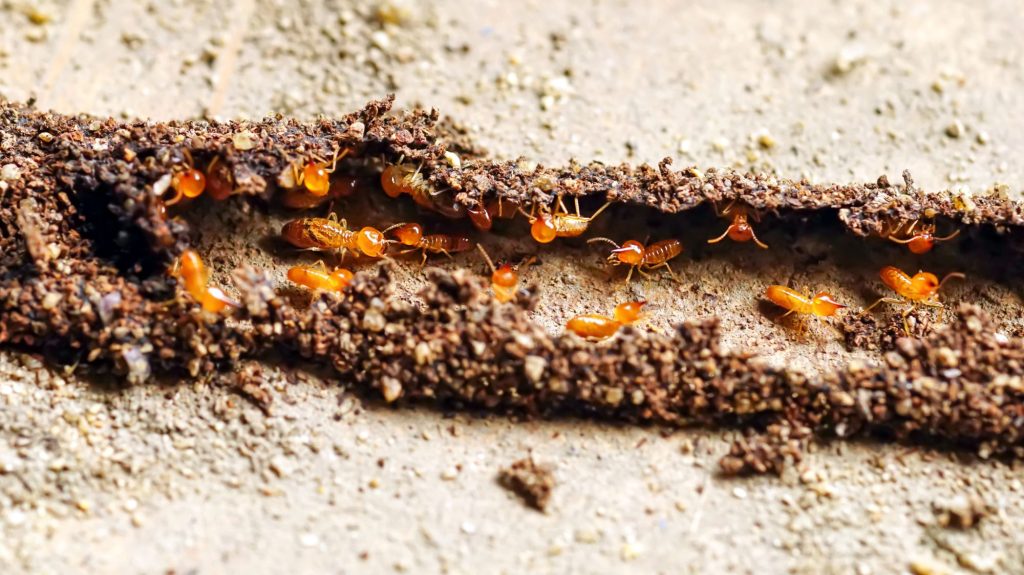
Because termites eat wood from the inside out, visible damage often means the infestation is severe. However, there are early warning signs. If you notice any of the following, you need immediate termite infestation treatment Singapore:
- Mud tubes on walls or skirting: These look like dirty veins running up your walls or across your ceiling. Break one open. If termites repair it within a few days, the colony is active .
- Hollow-sounding wood: Tap your skirting boards, door frames, or parquet flooring. Healthy wood sounds solid. Termite-damaged wood sounds papery or hollow .
- Tight doors and warped frames: As termites consume timber, moisture levels change, causing wood to warp. If your doors suddenly stick or windows won’t close properly, do not blame the weather .
- Frass (termite droppings): While more common with drywood termites activity leaves behind granular droppings near infested wood .
- Wings near windows: After rain, reproductive termites (swarmers) leave their colonies to mate. Finding piles of discarded wings is a sign that a colony is nearby .
If you see these signs, DIY sprays or home remedies will not work. When disturbed, termites simply migrate to another part of your house, continuing their destruction elsewhere . You need professional pest control Singapore immediately.
Termite Soil Treatment: The Gold Standard for Landed Properties
For landed homes and condos with ground contact, termite soil treatment is the most effective defence.
Why soil treatment?
Because subterranean termites come from the soil. If you only treat the wood you can see, the colony remains safe underground, sending new workers to attack from a different angle.
Termite soil treatment creates a continuous chemical barrier in the soil beneath and around your property . Here is how it works:
Inspection and Mapping
A licensed technician from the best pest control company Singapore can offer will first inspect your property to identify termite species, activity points, and the layout of your concrete slab relative to the soil .
Drilling and Rodding
Technicians drill small holes (approximately 16–18 mm in diameter) through concrete slabs, tiles, or along skirting lines. These holes are spaced roughly 30–45 cm apart to ensure complete coverage. In garden beds or exposed soil, they dig shallow trenches or use rodding to inject the treatment directly into the ground .
Injection of Termiticide
Approved termiticides (chemicals designed specifically to kill termites) are injected through each hole. The liquid spreads through the surrounding soil, forming a treated zone that termites cannot cross. Modern non-repellent termiticides have a transfer effect: termites that contact the treated zone carry the chemical back to the colony, spreading it to other workers and eventually the queen .
Patching and Cleanup
Once the injection is complete, technicians seal all drilled holes with cement or grout, leaving your floors intact and clean.
For a typical landed property in areas like Bukit Timah or Jurong, a full underground termite treatment Singapore job may require 90–130 drill points along a 50-metre perimeter, followed by follow-up inspections to confirm the colony has been eliminated .
Termite Baiting Systems vs. Liquid Barriers
When you search for termite control Singapore, you will encounter two primary professional methods: liquid soil barriers and baiting systems. Both have their place, and at Pestopia, we often use them together.
Liquid Soil Barriers (Corrective Treatment)
- How it works: Creates an immediate chemical zone in the soil that kills or repels termites on contact.
- Best for: Active infestations requiring rapid protection. Ideal for landed homes where technicians can access the full perimeter.
- Pros: Fast-acting, long-lasting (years with proper application).
- Cons: Requires drilling; cannot be used in all HDB situations.
Termite Baiting Systems
- How it works: Technicians install in-ground or above-ground bait stations around your property. The bait contains a slow-acting toxicant that worker termites eat and share with the colony, eventually eliminating the queen .
- Best for: Elimination, HDB units where soil treatment is not feasible, and eco-sensitive clients.
- Pros: Minimal drilling, highly targeted, very low toxicity to humans and pets.
- Cons: Takes weeks or months to eliminate the colony; requires ongoing maintenance.
At Pestopia, we often recommend a dual approach: soil treatment to protect the structure and a baiting programme to remove existing activity in skirting or built-in carpentry .
Why Choose Pestopia for Subterranean Termite Treatment Singapore?
You need more than chemicals—you need expertise. Pestopia is a trusted pest control Singapore provider, known for our rigorous standards and customer-first approach.
- NEA Licensed & Approved: We are an NEA approved pest control company, meaning our technicians hold the mandatory Vector Control Operator Certificate and use only government-approved chemicals .
- Advanced Detection: We use termite detector tools, including thermal imaging and moisture meters, to find hidden colonies before they cause structural failure.
- Customised for Your Property: Whether you need pest control HDB Singapore or pest control landed property Singapore, we tailor solutions to your specific construction and risk level.
- Safe for Families & Pets: Our eco friendly pest control Singapore methods prioritise your family’s safety while remaining lethal to termites.
- Comprehensive Coverage: From pest control for homes Singapore to commercial pest control Singapore (offices, warehouses, restaurants, factories), we do it all.
We also understand urgency. If you have active termites, you need fast pest control Singapore. Contact us for same day pest control Singapore or emergency pest control Singapore.
Protecting Your Investment Long-Term
Termite treatment does not end with the initial job. To keep your home safe, you need:
- Regular inspections: Annual or bi-annual pest inspection Singapore services to catch new activity early.
- Moisture control: Fix leaks, improve ventilation, and reduce wood-to-soil contact around your property .
- Professional monitoring: Bait stations should be checked regularly. Warranties on subterranean termite treatment Singapore often require ongoing professional oversight .
Do not wait until your floor sags or your door frame crumbles. The cost of termite treatment Singapore is always less than the cost of structural repair.
Frequently Asked Questions (FAQs)
1. How do I know if I need termite treatment Singapore?
If you see mud tubes, hollow-sounding wood, or discarded wings near windows, you likely have an active infestation. Contact Pestopia for a professional termite inspection Singapore immediately. DIY solutions will not eliminate the underground colony.
2. What is the difference between subterranean termites and drywood termites?
Subterranean termites live in the soil and build mud tubes to reach timber. They require moisture and cause the majority of structural damage in Singapore. Drywood termites live inside the wood itself and do not need soil contact, often infesting furniture. Effective subterranean termite control Singapore requires soil treatment or baiting, whereas drywood termites often need direct wood injection .
3. Is termite soil treatment safe for my family and pets?
Yes, when performed by an NEA certified pest control Singapore company like Pestopia. We use approved termiticides and follow strict safety protocols. Modern non-repellent termiticides have low toxicity to mammals and are applied directly into the soil, minimising exposure to residents. Baiting systems are even safer, often using active ingredients less toxic than table salt .
4. How much does professional termite treatment cost in Singapore?
Costs vary based on property size, infestation severity, and treatment type. Affordable pest control Singapore options exist, but for termites, you need comprehensive solutions. A baiting programme for a terrace house may start around S$1,800, while corrective soil treatment for a larger landed home is priced per linear metre. Contact Pestopia for a transparent quote based on your specific needs.
5. Can I perform termite treatment myself?
No. DIY termite sprays and foams only kill the termites you see—which represent less than 1% of the colony. The rest remain hidden underground, and disturbing them often causes the colony to split or migrate, worsening the problem . Always engage a professional pest control Singapore company with NEA licensing and experience in subterranean termite exterminator Singapore services.
Need Immediate Help? Contact Pestopia.
Do not let termites destroy your home’s value. Whether you need pest control for HDB flats Singapore, pest control for condos, or full-scale treatment for a landed bungalow, Pestopia delivers proven results.
We provide:
- 24 hr pest control Singapore for emergencies
- Building pest control Singapore for construction sites
- Pest control for businesses Singapore (restaurants, offices, warehouses, factories)
- Pest control for pets Singapore—safe for your furry friends
Get a free consultation today. Let us protect what matters most.
Citations
- Pestopia. (2024). Drywood vs. Subterranean Termites: How to Identify and Treat These Wood-Destroying Pests.
https://pestopia.sg/drywood-vs-subterranean-termites/ - Pestopia. (2025). Termite Pest Control Singapore: Get Termite Treatment Singapore.
https://pestopia.sg/termite-pest-control-singapore/ - Pestopia. (2025). NEA Licensed Pest Control: What It Means for Your Home.
https://pestopia.sg/nea-licensed-pest-control/ - National Environment Agency (NEA), Singapore. (2023). Pest Control – Termites.
https://www.nea.gov.sg/our-services/pest-control/termites - Lee, C. Y., & Su, N. Y. (Eds.). (2020). Biology and Control of the Subterranean Termite, Coptotermes gestroi, in Southeast Asia. National University of Singapore Press.
Note: Academic text, not a competitor. - Pestopia. (2025). Termite Soil Treatment: What Landed Homeowners Must Know.
https://pestopia.sg/termite-soil-treatment-landed-homes/ - Pestopia. (2025). Emergency Pest Control Singapore: Same Day Service.
https://pestopia.sg/emergency-pest-control-singapore/