


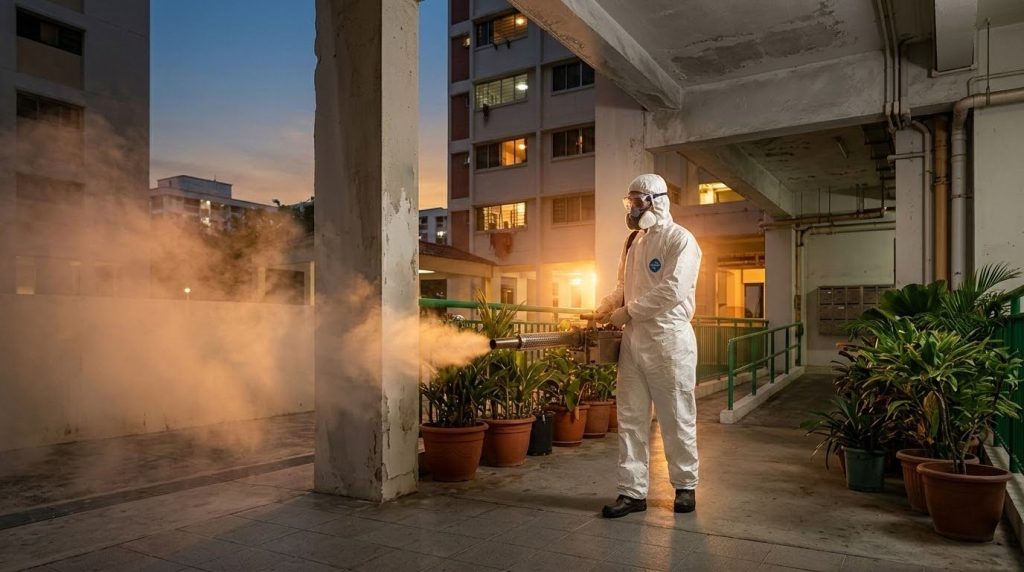
Singapore recorded over 32,000 dengue cases in 2023 – one of the highest yearly tallies in the nation’s history. In 2024, NEA continued to issue active dengue cluster alerts across multiple residential estates. The pattern is consistent: dengue season in Singapore never truly ends.
For homeowners and businesses, the question is not whether mosquitoes are a threat, but whether current prevention measures are adequate. This guide explains Singapore’s mosquito problem in detail, how to find and eliminate breeding sites, and why professional mosquito control Singapore services go far beyond what DIY repellents can achieve.
Singapore’s Mosquito Problem: Why It Never Goes Away
Singapore’s tropical climate – warm temperatures year-round, high humidity, and regular rainfall – creates perfect conditions for Aedes mosquito breeding. Unlike temperate countries with cold winters that disrupt breeding cycles, Singapore’s mosquitoes breed continuously throughout the year.
The primary culprit is Aedes aegypti, the dengue-transmitting mosquito. Unlike other species that breed in stagnant drains, Aedes aegypti prefers small, clean water containers – exactly the type found in and around homes.
NEA’s dengue surveillance data shows that the majority of breeding habitats detected during inspections are inside homes and gardens, not in public areas. This means individual homeowner behaviour directly impacts dengue risk for the entire neighbourhood.
How to Identify Aedes Mosquito Breeding Sites
Aedes mosquitoes do not need large water bodies to breed. A bottle cap with 5ml of water is sufficient. The most commonly missed breeding sites include:
Indoor Breeding Sites
- Flower pot plates: Standing water under indoor potted plants is among the top detected breeding sites in Singapore HDB inspections.
- Ornamental water features: Feng shui water bowls, vases with flowers, and tabletop fountains without aeration or treatment.
- Air conditioning drip trays: Poorly drained drip trays under split-unit air conditioners accumulate water quickly in Singapore’s humidity.
- Refrigerator drip trays: The collection tray underneath the refrigerator is rarely checked and commonly overlooked.
- Unused containers: Bowls, buckets, or empty bottles stored in service yards, store rooms, or balconies.
Outdoor Breeding Sites
- Bamboo pole holders: The hollow ends of bamboo drying poles collect rainwater. This is a notoriously common breeding site in HDB flats.
- Roof gutters and downpipes: Blocked gutters create standing water that persists for days after rain.
- Garden ornaments and plant saucers: Any garden item that holds water becomes a breeding container after rainfall.
- Tree holes and leaf axils: Natural depressions in trees and the base of palm fronds collect water.
- Drains and gully traps: Slow-flowing or blocked drains give mosquitoes time to lay eggs before water moves.
For HDB pest control Singapore residents, NEA recommends checking all the above sites weekly and removing or treating standing water immediately.
Mosquito Treatment Methods: Fogging vs. Misting vs. Larvicide
Not all mosquito treatments are the same. Understanding the difference helps homeowners choose the right approach.
Thermal Fogging
Fogging uses heated equipment to vaporise insecticide into a fine mist that penetrates dense vegetation, void spaces, and building interiors. It is highly effective at killing adult mosquitoes present at the time of treatment.
Fogging is the method NEA uses during dengue cluster response. For residential properties, scheduled fogging is ideal for gardens, carparks, void decks, and common areas.
Limitation: Fogging kills adult mosquitoes but does not eliminate larvae in water. A larvicide treatment must accompany fogging for complete protection.
Cold Misting (ULV)
Cold misting uses cold equipment to produce a fine particle spray. It covers large areas quickly with less heat and is suitable for indoor spaces such as warehouses, factories, and large commercial kitchens. Like fogging, ULV treats adult mosquitoes. Larvae in containers are not affected.
Larvicide Treatment
Larvicide is applied directly into water bodies – flower pot plates, drains, and any standing water that cannot be removed. It kills larvae before they develop into adult mosquitoes, breaking the breeding cycle.
Pestopia uses NEA-approved larvicide formulations including Bacillus thuringiensis israelensis (Bti) – a naturally occurring biological larvicide that targets mosquito larvae specifically without harming other organisms.
In2care
In2care installs Gravitrap systems throughout Singapore as a monitoring and population suppression tool. The Gravitrap attracts and traps female Aedes mosquitoes looking to lay eggs. While individual homeowners can purchase Gravitraps from In2care’s authorised retailers, they are a monitoring supplement – not a replacement for professional residential pest control Singapore treatments.
Homeowner Prevention Checklist (NEA’s 5-Step Mozzie Wipeout)
NEA’s Mozzie Wipeout programme recommends the following steps every week:
- Turn over all water storage containers or cover them tightly
- Change water in flower vases every other day
- Remove water from flower pot plates or add sand to absorb residual moisture
- Clear blockages in roof gutters and ensure they are free-flowing
- Add Bti larvicide granules to places where water cannot be removed (e.g. gully traps, roof gutters)
Following these steps consistently reduces breeding significantly – but does not replace professional treatment when a dengue cluster is active nearby or when the property has complex landscaping.
Pestopia’s Mosquito Control Programme
Pestopia provides NEA-approved mosquito control Singapore services for both residential and commercial properties.
Residential Mosquito Treatment
The residential programme includes a full property survey to identify all active breeding sites, larvicide treatment of all detected water bodies, scheduled fogging of garden and outdoor areas, and a written inspection report with recommendations for homeowners. For landed properties with gardens, swimming pools, or extensive landscaping, weekly, twice-monthly or monthly visits are recommended.
Commercial Mosquito Treatment
Schools, condominiums, restaurants with outdoor seating, and construction sites have significant mosquito control requirements. Pestopia’s commercial pest control Singapore programme for mosquitoes includes large-area ULV treatment, In2care installation and monitoring, larvicide programmes for drainage systems, and audit-ready service documentation.
Frequently Asked Questions
How often should fogging be done for dengue prevention?
For properties in or near active dengue clusters, monthly fogging combined with weekly breeding site inspections is the standard. For general prevention in non-cluster areas, quarterly treatments are typically sufficient. Pestopia assesses each property and recommends an appropriate frequency.
Is mosquito fogging safe for children and pets?
Pestopia uses NEA-approved formulations at regulated concentrations. Standard precautions apply: residents and pets should vacate treated areas during fogging and for 30 minutes afterwards. Food and water should be covered. Technicians provide clear safety instructions before every treatment.
Does fogging kill mosquito eggs?
No. Fogging and misting kill adult mosquitoes on contact. Eggs and larvae in water are not affected by fogging. This is why Pestopia always combines fogging with larvicide treatment – addressing both the adult population and the breeding cycle simultaneously.
Can I get fined for mosquito breeding in my home?
Yes. Under the Infectious Diseases Act, NEA officers can inspect premises and issue fines for mosquito breeding. First-time offences carry fines up to $200, with repeat offences attracting higher penalties and possible prosecution.
Stop Dengue Before It Starts
Professional mosquito control is the most reliable way to protect a home during Singapore’s year-round dengue risk. Pestopia provides NEA-approved fogging, larvicide treatment, and full breeding site assessments for HDB, condo, and landed properties.
Contact Pestopia today to schedule a mosquito inspection or enrol in a regular prevention programme.
References
National Environment Agency (NEA), Singapore. (2024). Dengue Surveillance and Mozzie Wipeout.
NEA Singapore. (2024). Mosquito Control — Aedes Mosquito Breeding Sites.
World Health Organisation (WHO). (2023). Dengue and Severe Dengue Fact Sheet.