“Professional pest control” appears in almost every pest control company’s marketing in Singapore, but the word does very little to tell a homeowner or facilities manager what they’re actually paying for. Two companies can both call themselves professional while one operates with a valid NEA licence, trained technicians, and a documented treatment plan, and the other doesn’t. Knowing what to check before booking is the difference between a genuine solution and a repeat problem six months later.
Start With Licensing, Not Reviews
Star ratings and testimonials are easy to accumulate and say nothing about whether a company is legally permitted to apply the pesticides it’s proposing to use. In Singapore, anyone carrying out pest control involving controlled chemicals must operate under a National Environment Agency Vector Control Operator registration, with individual technicians separately licensed or certified to handle the products in the field. A company can be entirely unlicensed and still run a professional-looking website, which is why licensing has to be the first thing verified rather than the last.
Ask directly for the company’s VCO registration number and the names of the technicians who will attend, then check that these are current. NEA’s registered operator list is publicly available through the government’s open data portal, so this step takes a few minutes and immediately separates legitimate operators from the rest.
What a Written Treatment Plan Should Include
A professional operator will explain, in writing, what pest is being targeted, which treatment method is proposed, what products will be used, and what follow-up is included. Vague language like “comprehensive treatment” or “full extermination service” without specifics is a common feature of lower-quality quotes, because it avoids committing to anything that can be checked afterward.
Ask what happens if the pest returns within a stated period — a credible company will have a warranty period built into its service terms, not an informal “we’ll come back if needed” verbal promise. The absence of a written warranty term is one of the more reliable red flags when comparing quotes that otherwise look similar on price.
Building Pest Control Needs a Different Standard Than a Single Flat
For commercial and building-wide contracts — offices, warehouses, condo management corporations — the standard should be higher again. A provider handling building pest control across common areas, waste facilities, and multiple tenants needs documented scheduling, incident reporting suitable for audits, and technicians experienced with commercial-scale baiting and monitoring programmes, not just residential-flat treatments scaled up. Ask commercial providers specifically about their reporting format, since facilities managers often need these records for internal compliance or insurance purposes.
Transparency About Products and Safety
A trustworthy operator will tell you which active ingredients are being used and why, particularly in homes with children, pets, or elderly residents. NEA’s Code of Practice for Vector Control Operators sets requirements around product handling, application method, and technician conduct on occupied premises, and a company operating within those standards should be able to discuss them without hesitation. If a technician is reluctant to name the product being applied or dismisses safety questions, that’s worth treating as a signal rather than dismissing as overcaution on your part.
Red Flags Worth Walking Away From
A few patterns show up repeatedly among the least reliable operators: requesting full payment upfront before any work is carried out, refusing to provide a written quote or scope of work, being unable to produce a VCO registration number on request, and offering prices dramatically below the rest of the market without a clear explanation for the gap. None of these alone proves a company is unlicensed or unreliable, but two or more together are reason enough to get a second quote before booking.
Insurance and Liability Cover Matter Too
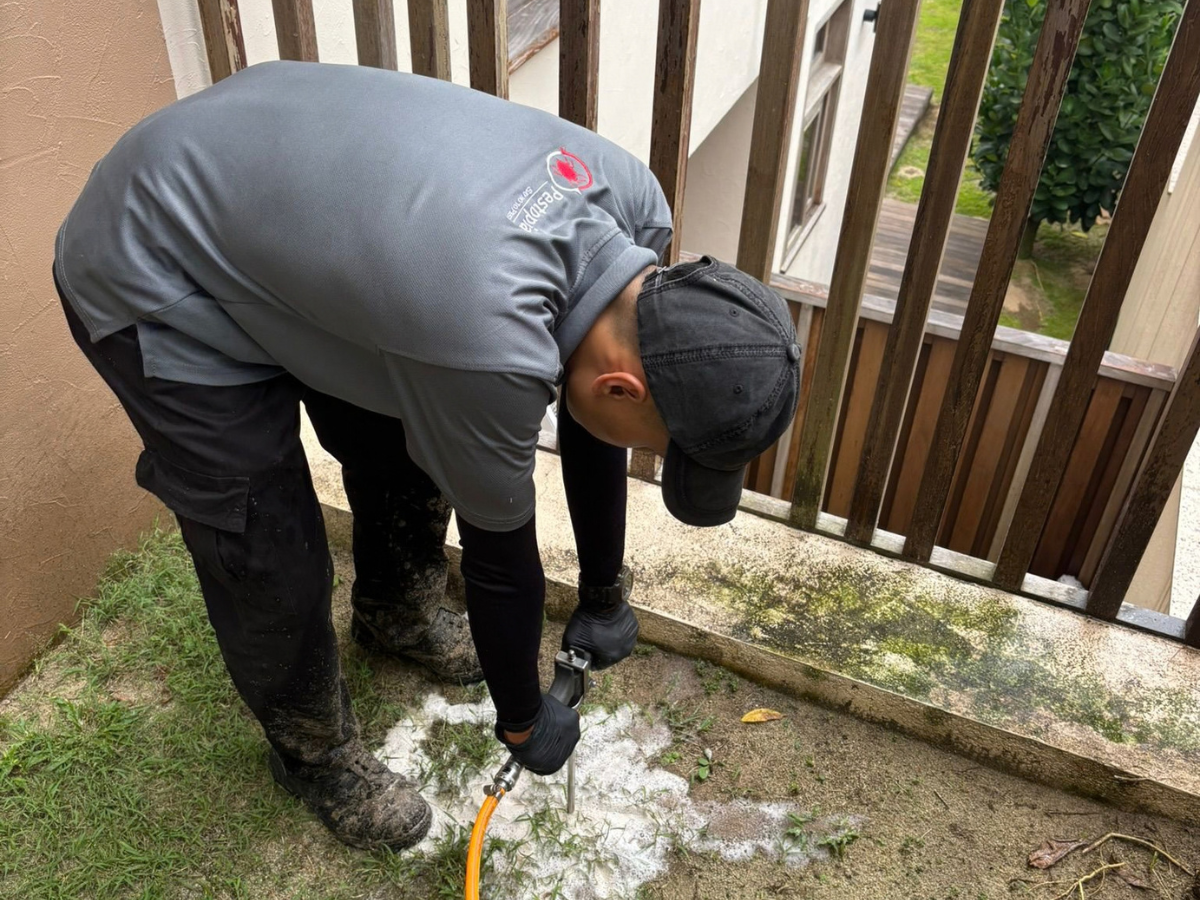
Beyond licensing, a professional operator should carry public liability insurance covering accidental property damage during treatment — drilling into a pipe during termite soil injection, for instance, or damage caused by equipment in a tight service yard. This is easy to overlook when comparing quotes on price and scope alone, but it becomes very relevant if something does go wrong mid-treatment. Ask whether the company carries liability cover and whether it extends to subcontracted technicians, since some smaller operators rely on freelance staff who may not be covered under the same policy.
For strata-managed condos and commercial buildings in particular, management corporations and facilities teams often require proof of insurance before approving a vendor, so this is worth confirming early rather than after a contract has already been signed.
Trade Association Membership as a Secondary Signal
While NEA licensing is the mandatory baseline, membership in an industry body such as the Singapore Pest Management Association can be a useful secondary signal, since these associations typically require members to meet certain operating standards and provide a channel for raising complaints that falls outside formal NEA enforcement. It shouldn’t replace checking licensing directly, but it does indicate a company has some level of industry accountability beyond the legal minimum.
Making the Comparison Easier
Comparing quotes side by side works best when you ask every company the same set of questions: licence number, technician certification, product names, treatment method, warranty period, and what a follow-up visit costs if the pest returns. Providers who answer all six clearly and quickly tend to be the ones running a properly documented operation. Pestopia publishes its NEA registration details and treatment terms upfront for exactly this reason — homeowners and facilities managers shouldn’t have to chase down basic credentials before deciding who to hire.
For readers weighing a residential decision specifically, our piece on [LINK TO: Post 3 — HDB vs. Condo Pest Control in Singapore: What’s Actually Different?] covers how building type affects which questions matter most when vetting a provider.
Frequently Asked Questions
Is a higher price always a sign of a more professional company?
Not necessarily, but an unusually low price with no written scope or warranty is more often a red flag than a bargain. Price should be compared alongside licensing, documentation, and warranty terms, not on its own.
Can I check a company’s NEA licence myself before they arrive?
Yes. NEA’s Vector Control Operator information is available through the government’s open data portal, and a legitimate company will have no issue confirming their registration number in advance.
Do all pest control jobs require a licensed technician, or only large ones?
Any vector control work involving regulated pesticides against mosquitoes, cockroaches, rodents, flies, or rat fleas requires a licensed or certified technician, regardless of job size.
What should a warranty period actually cover?
It should specify how long the company will return at no extra cost if the same pest issue recurs, and under what conditions that warranty is void — for example, if structural repairs weren’t completed as recommended.
Is a written report necessary for a small residential job?
It’s still good practice. A written report — even a brief one covering what was found, what was applied, and any recommendations — gives you a record for future reference or if you need to raise a warranty claim later.
Book With a Provider That Can Show Its Credentials
Choosing a pest control company shouldn’t require guesswork. Pestopia is a fully NEA-registered operator with documented treatment plans and clear warranty terms for every job — get in touch for a straightforward, written quote before your next booking.
REFERENCES:
(Minimum 2–3 required — format: Author/Organisation. (Year). Title. Website. URL)
- National Environment Agency. (2026). Vector Control Operator. NEA Singapore. https://www.nea.gov.sg/our-services/pest-control/vector-control-operator
- National Environment Agency. (2024). Registered Vector Control Operator (VCO) [Dataset]. data.gov.sg. https://data.gov.sg/datasets/d_0921c2daa08b8bd846d2405c934da8c6/view
- National Environment Agency. (2025). Code of Practice for Vector Control Operator, Technician and Worker. NEA Singapore. https://www.nea.gov.sg/docs/default-source/our-services/pest-control/vector-control-operator/code-of-practice-for-vector-control-operator-technician-and-worker96ca394d31a74736b1bbcff06cd36678.pdf